Text Resize
Mobile Video Button

Sale and Unitrust

Are your appreciated assets, such as stock, bonds or real estate, producing little or no income?

If you sell your appreciated assets, you will pay a large capital gains tax. A sale and charitable remainder unitrust may be the solution to avoid capital gains tax.
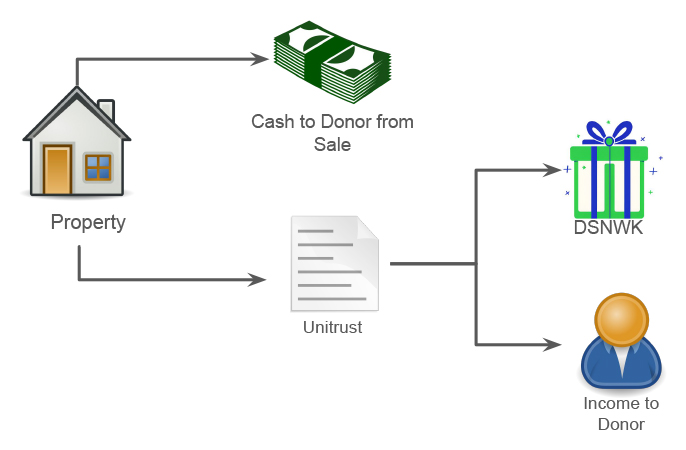
Flowchart: Donor transfers an undivided portion of property to a unitrust. When property is sold, the donor and the unitrust receive cash from the sale. The donor receives payouts from the unitrust and the DSNWK receives the remainder at the end of the trust term.

Benefits of a sale and unitrust

  • Receive cash from the sale. You can use this cash to purchase another residence, to save for retirement, to travel, to meet your daily needs or to meet some other financial goal
  • Receive income from the unitrust for the rest of your life and future retirement
  • Obtain an income tax deduction that may reduce your tax bill this year
  • Further the work of Developmental Services of Northwest Kansas with your gift

How a sale and unitrust works

  1. You establish a charitable remainder unitrust and transfer a portion of your assets to the trust.
  2. The assets are then sold. You receive cash from the sale, and the rest of the sale's proceeds are paid to the charitable unitrust.
  3. The trust will provide you with income for the rest of your life.
  4. You receive a charitable deduction this year to offset your tax on the cash proceeds that you receive from the sale.

More on sale and unitrust

When transferring a portion of your primary residence to fund a unitrust, you may apply your one-time home exclusion to reduce or eliminate capital gains tax that would otherwise be due from the sale. Your tax advisor can assist you to determine if you should utilize this strategy.

Contact us

If you have any questions about a sale and unitrust, please contact us. We would be happy to assist you and answer any questions you might have.

Unitrust and Sale Calculator

Help
Unitrust and Sale
Trust Type
Trust Type
Click the appropriate button for a One-Life or Two-Life presentation. Selecting One Life will cause the Second Person and the associated name and age fields to be hidden from view for that run.
*
Enter the name of the person. You may use such titles as "Mr.", "Mrs.", "Dr.", "Rev.", "Jr.", "Sr.", etc. For the remainder unitrust the first person is the first income recipient or beneficiary of the agreement.
*
You may enter the age of the person instead of the birth date. However, if the birth date is known, click on the calendar icon and choose your birth date. Since ages are to be rounded up if the gift date is within 6 months of the next birth date, entering the birth date is the most accurate method.
*
*
Income Tax Rate
Income Tax Rate
Select the current federal income tax rate of the donor. This will be used to project possible income tax savings. If you are not certain about the correct rate, you may choose one of the middle rates. For many people, this will be close to the actual income tax rate.
*
Enter the amount of cash or the fair market value (FMV) of the asset(s) used to fund the CGA. For assets such as real estate, closely-held stock and other hard to value assets, the FMV would be the appraised value of the property on the date of the gift.
*
Enter the cost basis of the asset being used to fund the trust or annuity. If the asset is cash, the cost basis is equal to the gift amount. If it is appreciated property, the cost basis will most likely be the amount you originally paid for the property. The cost basis is used to determine the capital gains tax which will be bypassed as a result of selling the asset. If the cost basis is not known or cannot be proven, the IRS assumes the cost basis to be $0. If cash funds the gift annuity, enter the same value as "Value of Property."
*
Enter the current return return or yield of the asset(s) which will be used to fund the gift agreement. For example, if the trust will be funded with public-traded stock which is currently paying a dividend of 3%, the current return yield is, in turn, 3%. If the gift is funded with vacant land or a personal residence (assuming the property is not leased), the current return would be 0%.
*
Enter the percent income payout to the donor. You must select a trust percent payout of 5% or more.
*
Enter the amount of cash you wish to receive from the sale of the asset(s) that will be used to fund the trust. This amount of cash will not go into the trust.
Payment Frequency
Payment Frequency
Select either monthly, quarterly, semiannual, or annual income payments to the beneficiary(ies) of the income. The choice of payment frequency does affect the amount of the charitable deduction as the more frequent the payment (i.e. monthly as opposed to annually), the smaller the donor's tax deduction.
* Required Fields
scriptsknown